← Back to Insights
AI Marketing
The Post-Scale Of AI Revolution!!!
Abdulrahman Jalloh
•
Jul 23, 2026
•
Abdulrahman 5 Min Read!
Why Specialized, Local Models Are the New Gold Rush...
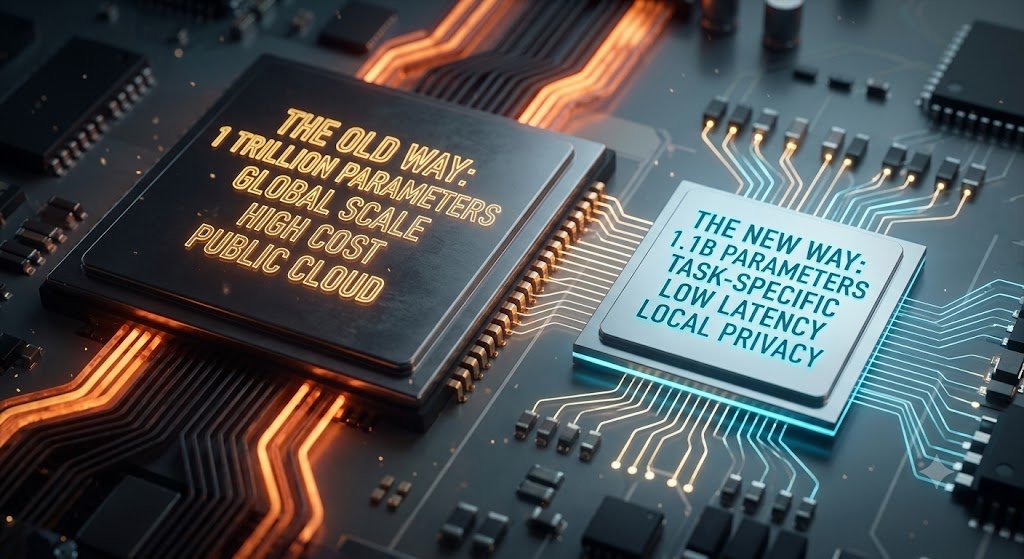
For a long time, the dominant narrative in artificial intelligence was "bigger is better." We watched in awe as parameters ballooned, requiring entire data centers to train. But as we move past the novelty phase of large-scale generative AI, a new reality is emerging. For businesses looking for real ROI and practical deployment, scale is giving way to precision and efficiency.
The new tech gold rush isn't for the largest model; it's for the most efficient and task-specific one, deployable anywhere—even on a user's phone.
The Problem with Scale: Cost, Power, and Privacy
While massive models are impressive generalists, deploying them in a production environment is fraught with challenges.
Inference Costs: Running huge models in the cloud generates massive per-request costs that can kill unit economics, especially for high-volume consumer apps or always-on business tools.
Power and Sustainability: The compute power required is staggering, raising significant environmental concerns and straining global energy grids.
Data Privacy & Security: For most corporate applications, sending sensitive data—medical records, financial legal text—to a third-party API is a non-starter. This is forcing the demand for models that can run fully on-premise or on an isolated virtual private cloud.
The Specialized Solution: Tiny is the New Big
We are seeing a profound pivot toward "SLMs"—Small Language Models (or small foundation models in other modalities like computer vision). These are models with perhaps 1-billion to 7-billion parameters, trained on highly curated, high-quality data.
The industry is rapidly converging on these advantages:
Task-Specific Dominance: A 1-billion parameter model trained purely on financial contracts often outperforms a generalist LLM for contract analysis, and it does so while being thousands of times smaller.
Edge Computing & Mobility: We are on the cusp of "Local AI." New neural processing chips (NPUs) in smartphones, laptops, and automobiles allow these smaller models to run directly on the device. This provides zero-latency responses and guarantees total privacy.
The Rise of the Foundation Finetuner: The new business edge isn't in building the model, but in fine-tuning it with a proprietary dataset. This is where small businesses can create massive value.
What This Means for Your Business Strategy
If you are a tech-focused business or any company looking to integrate AI, the strategic imperative has shifted:
Stop Chasing Benchmarks: Don't get caught up in who has the highest general knowledge score. Define the specific task you need the AI to perform.
Analyze Your Local Infrastructure: Can you move inference to your own infrastructure or, ideally, your user's devices? This creates a massive moat in terms of privacy and cost.
Own Your Data Pipeline: The differentiator is your data. A small, efficient model is useless without a proprietary, high-quality dataset to fine-tune it.
The era of "one gigantic model to rule them all" is ending. The future is an ecosystem of specialized, nimble, and private intelligence. Which one will you build?
For a long time, the dominant narrative in artificial intelligence was "bigger is better." We watched in awe as parameters ballooned, requiring entire data centers to train. But as we move past the novelty phase of large-scale generative AI, a new reality is emerging. For businesses looking for real ROI and practical deployment, scale is giving way to precision and efficiency.
The new tech gold rush isn't for the largest model; it's for the most efficient and task-specific one, deployable anywhere—even on a user's phone.
The Problem with Scale: Cost, Power, and Privacy
While massive models are impressive generalists, deploying them in a production environment is fraught with challenges.
Inference Costs: Running huge models in the cloud generates massive per-request costs that can kill unit economics, especially for high-volume consumer apps or always-on business tools.
Power and Sustainability: The compute power required is staggering, raising significant environmental concerns and straining global energy grids.
Data Privacy & Security: For most corporate applications, sending sensitive data—medical records, financial legal text—to a third-party API is a non-starter. This is forcing the demand for models that can run fully on-premise or on an isolated virtual private cloud.
The Specialized Solution: Tiny is the New Big
We are seeing a profound pivot toward "SLMs"—Small Language Models (or small foundation models in other modalities like computer vision). These are models with perhaps 1-billion to 7-billion parameters, trained on highly curated, high-quality data.
The industry is rapidly converging on these advantages:
Task-Specific Dominance: A 1-billion parameter model trained purely on financial contracts often outperforms a generalist LLM for contract analysis, and it does so while being thousands of times smaller.
Edge Computing & Mobility: We are on the cusp of "Local AI." New neural processing chips (NPUs) in smartphones, laptops, and automobiles allow these smaller models to run directly on the device. This provides zero-latency responses and guarantees total privacy.
The Rise of the Foundation Finetuner: The new business edge isn't in building the model, but in fine-tuning it with a proprietary dataset. This is where small businesses can create massive value.
What This Means for Your Business Strategy
If you are a tech-focused business or any company looking to integrate AI, the strategic imperative has shifted:
Stop Chasing Benchmarks: Don't get caught up in who has the highest general knowledge score. Define the specific task you need the AI to perform.
Analyze Your Local Infrastructure: Can you move inference to your own infrastructure or, ideally, your user's devices? This creates a massive moat in terms of privacy and cost.
Own Your Data Pipeline: The differentiator is your data. A small, efficient model is useless without a proprietary, high-quality dataset to fine-tune it.
The era of "one gigantic model to rule them all" is ending. The future is an ecosystem of specialized, nimble, and private intelligence. Which one will you build?