← Back to Insights
AI Marketing
Beyond Traditional SEO:
Abdulrahman Jalloh
•
Jul 26, 2026
•
6 Min read
How Generative Engine Optimization (GEO) and Search Everywhere Optimization (SEO) is Changing Digital Marketing in 2026
Category: AI Marketing & SEO
By Abdulrahman Jalloh
The search landscape has officially shifted. If your current marketing strategy relies solely on ranking for traditional 2- or 3-word keywords on traditional search engine results pages, you might already be noticing a dip in organic website traffic.
In 2026, potential clients aren't just typing short terms like best web designer into search bars. They are asking AI assistants detailed, conversational questions like, Which digital marketing strategy should a local service business use to increase lead conversions this quarter?
Welcome to the era of Generative Engine Optimization (GEO) and Search Everywhere Optimization (SEO). Here is what this shift means for your business and how you can adapt your online strategy to stay ahead.
What Is Generative Engine Optimization (GEO)?
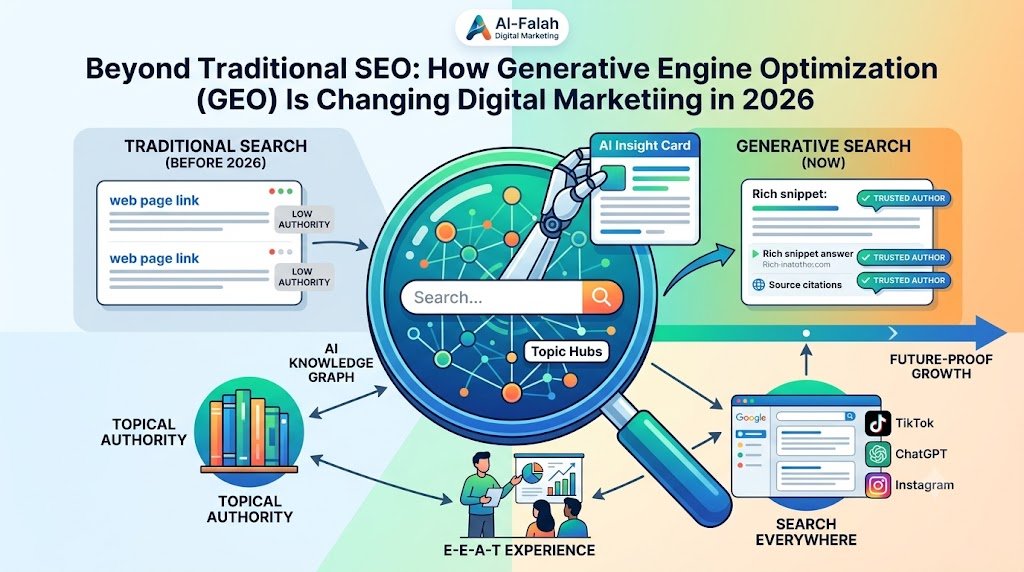
While traditional SEO focuses on optimizing web pages to rank high on search engine result pages, Generative Engine Optimization (GEO) optimizes your content so that AI engines—such as ChatGPT, Gemini, Perplexity, and AI Search Overviews—cite and recommend your brand in their generated responses.
When AI platforms answer user queries, they use a process called query fan-out, pulling context, data, and insights from authoritative across the web. If your business isn't structured to be recognized as a trusted authority by these AI systems, you risk becoming invisible to a rapidly growing segment of buyers.
3 Pillars of a Winning GEO Strategy in 2026
To ensure your brand gets cited and recommended by AI engines and modern search platforms, focus on these three essential pillars:
1. Build Topical Authority (Not Just Keywords)
AI search engines prioritize depth over keyword density. Instead of creating isolated, thin articles targeted at individual keywords, structure your website content into comprehensive content hubs.
Create a main pillar page covering a core service or industry topic in detail.
Surround it with interconnected, highly specific articles that answer niche, long-tail questions.
Establish clear internal links connecting all related pieces.
2. Double Down on First-Hand Experience & E-E-A-T
AI-generated content is everywhere, which makes human experience, authority, and trust more valuable than ever. Search platforms favor content that demonstrates real-world expertise (E-E-A-T: Experience, Expertise, Authoritativeness, Trustworthiness).
Include real case studies, proprietary data, and customer stories.
Attribute articles to named industry experts with verifiable credentials.
Embed quotes, original research, and actionable takeaways that AI platforms can easily reference.
3. Structure Your Content for AI Readability
AI answer engines scan for clear, logical formatting to summarize information accurately. Make your website easy for crawlers to parse:
* Use direct, question-based subheadings (H2s and H3s).
* Organize complex comparisons into concise tables and bulleted lists.
* Provide clear, upfront answers immediately following each question header before diving into detailed explanations.
The Rise of "Search Everywhere Optimization"
Visibility in 2026 isn't limited to a single search box. Customers discover and evaluate brands across multiple touch points—including social media platforms, short-form video, niche forums, and AI search tools.
Adopting a Search Everywhere approach means ensuring your brand's core message, visual identity, and customer value proposition remain consistent across every digital channel. When your messaging is aligned across social channels, video content, and your official website, search engines and AI tools gain higher confidence in recommending your business.
Key Takeaways for Small Business Owners
Focus on intent: Address the specific reasons, goals, and questions behind your potential clients' searches.
Prioritize clarity over cleverness: Well-structured, direct content outperforms vague or overly promotional copy.
Make your brand citable: Publish unique insights, authentic reviews, and real case studies that showcase your real-world experience.
Ready to Modernize Your Digital Marketing Strategy?
At Al-Falah Digital Marketing, we help growing businesses navigate AI-driven search, web design, and data-backed marketing strategies that deliver measurable results.
[Contact our team today] to audit your digital presence and build a future-proof growth plan.
Category: AI Marketing & SEO
By Abdulrahman Jalloh
The search landscape has officially shifted. If your current marketing strategy relies solely on ranking for traditional 2- or 3-word keywords on traditional search engine results pages, you might already be noticing a dip in organic website traffic.
In 2026, potential clients aren't just typing short terms like best web designer into search bars. They are asking AI assistants detailed, conversational questions like, Which digital marketing strategy should a local service business use to increase lead conversions this quarter?
Welcome to the era of Generative Engine Optimization (GEO) and Search Everywhere Optimization (SEO). Here is what this shift means for your business and how you can adapt your online strategy to stay ahead.
What Is Generative Engine Optimization (GEO)?
While traditional SEO focuses on optimizing web pages to rank high on search engine result pages, Generative Engine Optimization (GEO) optimizes your content so that AI engines—such as ChatGPT, Gemini, Perplexity, and AI Search Overviews—cite and recommend your brand in their generated responses.
When AI platforms answer user queries, they use a process called query fan-out, pulling context, data, and insights from authoritative across the web. If your business isn't structured to be recognized as a trusted authority by these AI systems, you risk becoming invisible to a rapidly growing segment of buyers.
3 Pillars of a Winning GEO Strategy in 2026
To ensure your brand gets cited and recommended by AI engines and modern search platforms, focus on these three essential pillars:
1. Build Topical Authority (Not Just Keywords)
AI search engines prioritize depth over keyword density. Instead of creating isolated, thin articles targeted at individual keywords, structure your website content into comprehensive content hubs.
Create a main pillar page covering a core service or industry topic in detail.
Surround it with interconnected, highly specific articles that answer niche, long-tail questions.
Establish clear internal links connecting all related pieces.
2. Double Down on First-Hand Experience & E-E-A-T
AI-generated content is everywhere, which makes human experience, authority, and trust more valuable than ever. Search platforms favor content that demonstrates real-world expertise (E-E-A-T: Experience, Expertise, Authoritativeness, Trustworthiness).
Include real case studies, proprietary data, and customer stories.
Attribute articles to named industry experts with verifiable credentials.
Embed quotes, original research, and actionable takeaways that AI platforms can easily reference.
3. Structure Your Content for AI Readability
AI answer engines scan for clear, logical formatting to summarize information accurately. Make your website easy for crawlers to parse:
* Use direct, question-based subheadings (H2s and H3s).
* Organize complex comparisons into concise tables and bulleted lists.
* Provide clear, upfront answers immediately following each question header before diving into detailed explanations.
The Rise of "Search Everywhere Optimization"
Visibility in 2026 isn't limited to a single search box. Customers discover and evaluate brands across multiple touch points—including social media platforms, short-form video, niche forums, and AI search tools.
Adopting a Search Everywhere approach means ensuring your brand's core message, visual identity, and customer value proposition remain consistent across every digital channel. When your messaging is aligned across social channels, video content, and your official website, search engines and AI tools gain higher confidence in recommending your business.
Key Takeaways for Small Business Owners
Focus on intent: Address the specific reasons, goals, and questions behind your potential clients' searches.
Prioritize clarity over cleverness: Well-structured, direct content outperforms vague or overly promotional copy.
Make your brand citable: Publish unique insights, authentic reviews, and real case studies that showcase your real-world experience.
Ready to Modernize Your Digital Marketing Strategy?
At Al-Falah Digital Marketing, we help growing businesses navigate AI-driven search, web design, and data-backed marketing strategies that deliver measurable results.
[Contact our team today] to audit your digital presence and build a future-proof growth plan.